
AQUAFIGHTER® · WATER MANAGEMENT
Aquafighter diesel tank water removal
Aquafighter is an in-tank water-removal filter for diesel and biodiesel blends. It captures water within its filter material for removal from the tank.
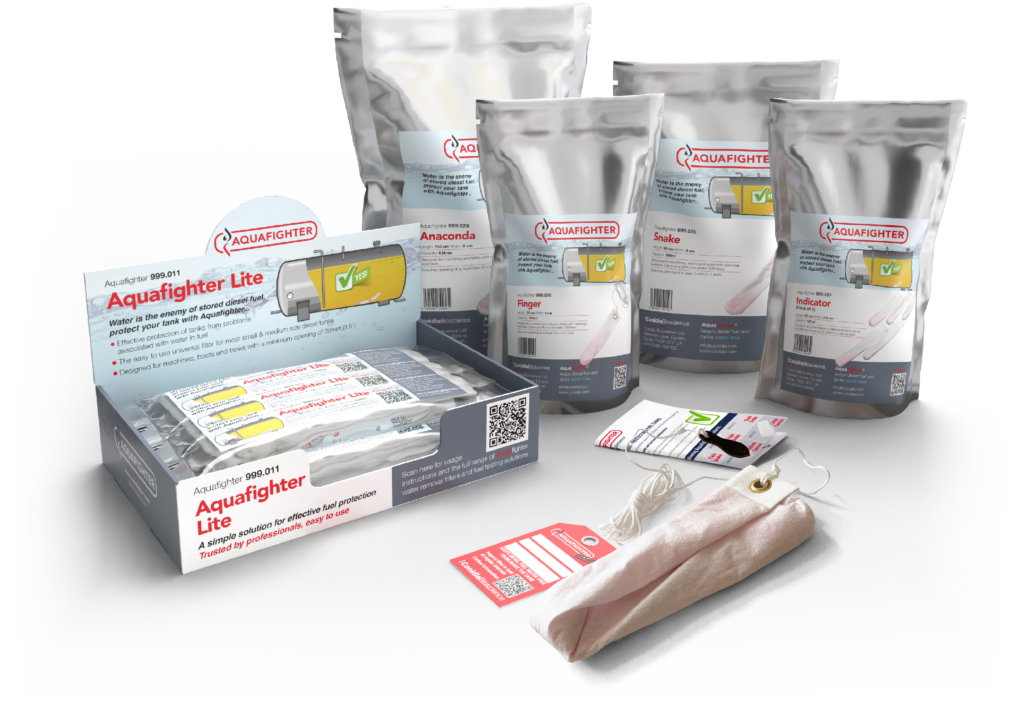
Start with the tank, not just the product
Choose a suitable Aquafighter by checking the tank opening first, then tank capacity and maintenance requirements. The selected model must be accessible for inspection and removal.
Aquafighter works best in a clean tank. Where sludge or microbial contamination is present, assess the fuel and tank condition before installing a water absorber.
How it fits into fuel care
- Assess: Check fuel condition, tank cleanliness and water accumulation.
- Select: Match the filter to tank access, capacity and inspection arrangements.
- Install: Follow the manufacturer’s instructions for positioning and retrieval.
- Inspect: Check the filter periodically and replace it as it approaches capacity.
Water removal does not establish that fuel meets every quality requirement. Investigate other contamination or degradation where necessary.
Product formats
The range includes Snake and Anaconda water absorbers and a Dipstick Indicator for checking water in diesel fuel. Confirm the model and its current instructions before ordering.
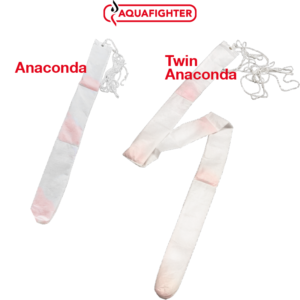
Selection information
When enquiring, provide:
- Fuel type and tank capacity.
- Tank access-opening dimensions.
- Observed water or contamination.
- Inspection and replacement arrangements.
Water management and microbial testing
Use water management and microbial testing as complementary controls. FUELSTAT testing helps assess microbial contamination; Aquafighter addresses water in suitable stationary diesel tank applications. Establish the tank condition and the decision you need to make before selecting either product.
Compare the complete Aquafighter range
The range below is provided as a selection starting point, not a substitute for the current Conidia fit guide. Confirm actual opening dimensions, fuel condition, operating environment and a safe retrieval arrangement before installation.
| Model | Manufacturer SKU | Selection considerations | Product |
|---|---|---|---|
| Finger | 999.020 | Small diesel tanks; suitable opening ≥38 mm | View product |
| Lite | 999.011 | Compact storage applications; 38–90 mm opening | View product |
| Snake | 999.026 | Longer in-tank water absorber, generally through ≥38 mm openings | View product |
| Twin Snake | 999.027-1 | Greater holding capacity than a single Snake | View product |
| Triple Snake | 999.027-2 | Larger stored-diesel systems | View product |
| Quad Snake | 999.027-3 | Larger storage tanks and planned inspection cycles | View product |
| Anaconda | 999.028 | Larger tanks and ≥90 mm openings | View product |
| Twin Anaconda | 999.040 | Higher-capacity Anaconda configuration | View product |
| Medium Canvas | 999.021 | Canvas format; confirm opening, tank capacity and inspection interval against the current fit guide | Enquire |
| Large Canvas | 999.022 | Larger Canvas format; confirm access and retrieval against the current fit guide | Enquire |
| Fuel Station Mat | 999.042 | Large fuel stations and tanks above 15,000 L | Enquire |
| Depot | 999.030 | Large depot/terminal fuel storage | Enquire |
| Dipstick Indicator | 999.023 | Inspection of water presence in diesel fuel tanks | View product |
| Dipstick Refills (5) | 999.024 | Replacement indicator refills | Enquire |
For quotation-only models, contact the technical team to confirm the exact item and supply requirements. The water-holding and replacement period must be selected for the installation rather than extrapolated from tank size alone.
Use Aquafighter as part of a controlled water-management plan
1. Diagnose the tank condition
Inspect and sample fuel, review tank-bottom water and sludge, and check the history of deliveries, filtration and maintenance. Where microbial contamination is suspected, consider representative FUELSTAT testing. Serious sludge, recurring water or visibly contaminated fuel may require emptying and cleaning before installing an absorber.
2. Drain significant free water
Where a tank contains substantial free water, drain it using a suitable controlled procedure. Aquafighter can then help manage remaining bound or emulsified water under the manufacturer’s stated conditions.
3. Select and install safely
Measure the actual usable opening, match the model to the tank size, and secure the retrieval cord or installation hardware according to Conidia instructions. The device must remain accessible, not obstruct fuel pickup or interfere with safe operation. Before starting a vehicle or boat engine, remove Aquafighter from the tank as directed by Conidia. Only use while the tank is stationary; securing the cord does not remove this restriction.
4. Monitor saturation and replace
Check after initial installation—earlier where fuel condition is uncertain—and at the stated service intervals. Replace at the manufacturer’s saturation criterion, rather than treating the product as permanently maintenance-free. Document the tank condition and replacement dates.
5. Confirm results
Sampling and inspection determine whether further remediation is warranted. An Aquafighter product does not kill microbes, remove settled sediment or replace fuel polishing, tank cleaning or appropriate testing.
Frequently asked questions and technical documents
Aquafighter captures water in an absorbent filter placed inside a suitable tank. Its purpose is water management in diesel and biodiesel blends; it is not a liquid additive or a substitute for a complete fuel-quality assessment.
Measure usable tank access first, then consider tank volume, water loading and inspection arrangements. Check the manufacturer’s current fit guide for the model. Include bends, obstructions and the retrieval route when describing the installation to Fuel Right.
Drain or otherwise remove significant free water first. Use Aquafighter for the remaining water-management duty in an appropriately assessed tank. Repeated water accumulation also requires investigation of the source.
No. Water control, microbial testing and physical remediation are separate tasks. Existing sludge or microbial contamination needs assessment before installation; a dirty tank can impair the filter’s performance.
No. Conidia’s procedure requires removal before starting the vehicle or boat engine to avoid interference with the tank’s components or fuel supply. Use only while the tank is stationary and follow the exact product instructions for removal and reinstallation.
Follow the model instructions and record inspections. Conidia calls for regular checks, with earlier checks at first installation or with high water loading. Its guidance recommends replacement when more than half the filter has turned red. Never assume a calendar interval guarantees remaining capacity.
This page is focused on diesel applications. Conidia excludes ethanol-containing fuels. Do not use a diesel listing as approval for a petrol application: confirm the exact fuel and model with the technical team before ordering.
These perform different duties. Review the complete tank and fuel-transfer system before changing existing filtration or separation arrangements. Where contamination persists, establish the cause and select the appropriate removal and verification methods.
No. Appearance is useful for inspection but is not a numerical water-content measurement. If an operating or acceptance limit must be demonstrated, arrange the appropriate analysis and record the sampling point and conditions.
Only after checking the installations. Tank access, capacity and maintenance access may differ across a network. Maintain a model register by tank and assign inspection responsibility rather than selecting purely by total litres stored.
Record tank and site identifiers, model, installation date, inspection findings, replacement date, water observations and any corrective action. Track unusually fast saturation as a reason to investigate water ingress or fuel deliveries.
Compare the complete programme cost: devices, inspection labour, replacement, testing and waste handling. Use your own before-and-after records for water findings, filter changes and disruption. Do not assume a guaranteed saving or service life.
Provide fuel type, tank capacity, usable access dimensions, number of tanks, water/sludge observations, whether the tank moves during operation, and the inspection/retrieval plan. Include photographs of access where useful, without opening a tank outside site procedures.
Manufacturer instructions and fit guide
Find the right Aquafighter for your tank
Discuss tank access and fuel conditions with Fuel Right Australia. Confirm model suitability, availability and pricing before ordering.