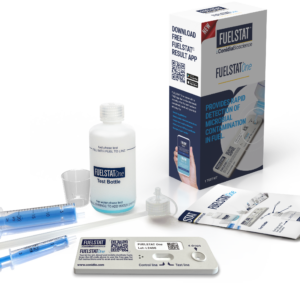
FUELSTAT One and FUELSTAT Plus provide practical on-site testing for microbial contamination in diesel, middle-distillate and aviation fuel systems. Diagnose before deciding on cleaning, water management or corrective treatment.
Choose the test by the decision you need to make, not just its speed. Both are designed for on-site use; neither is a fuel treatment. Product versions for diesel and aviation fuel must be selected correctly.
FUELSTAT One
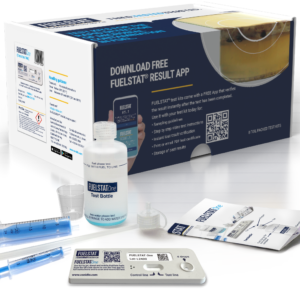
Quantitative microbial assessment. Lateral-flow technology identifies broad microbial markers. The free FUELSTAT Result app reads the test and provides quantitative results and a digital report in approximately 20–30 minutes from sampling.
Available: Diesel or aviation/jet versions, single test or box of eight. Manufacturer shelf life: 18 months from manufacture.
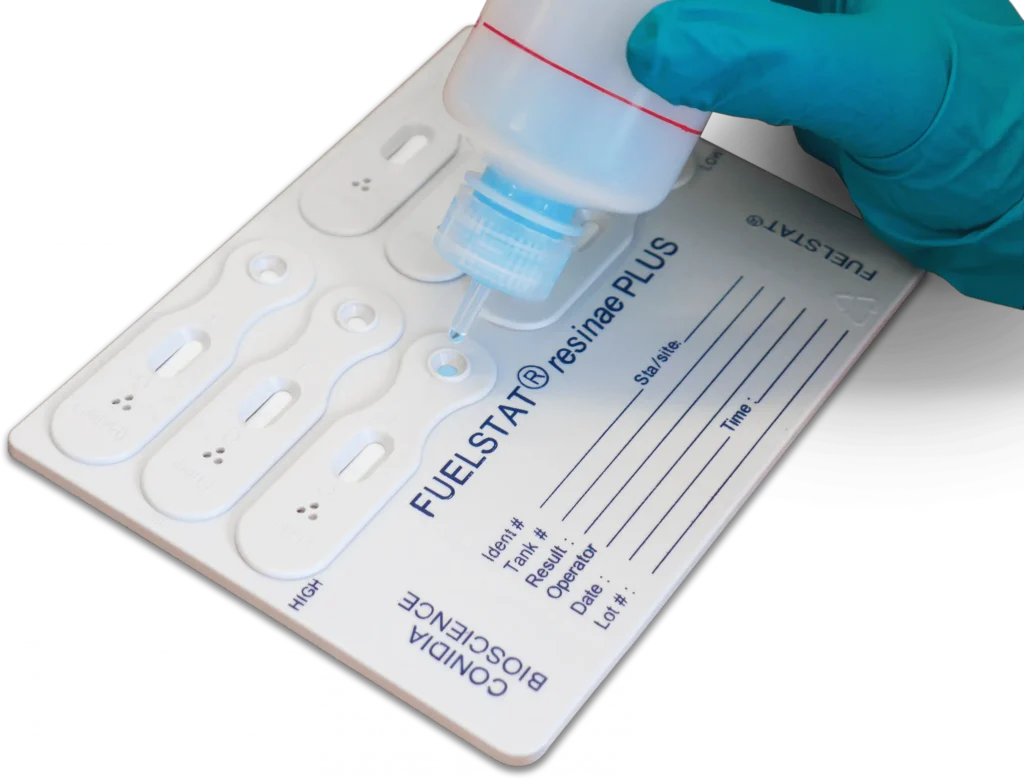
Rapid semi-quantitative screening. Antibody immunoassay technology targets specified fuel-degrading microorganisms and provides an on-site result in approximately 15 minutes, following sample preparation.
Available: Diesel or aviation/jet versions, single test or box of eight. Manufacturer shelf life: 30 months from manufacture; Conidia identifies ASTM D8070 compliance for Plus.
1. Test: Collect representative samples from the appropriate fuel or water phase, using the manufacturer and applicable industry sampling procedures.
2. Understand: Read the result within the specified period; use the FUELSTAT Result app where required, review fuel history and inspect tank condition.
3. Treat: Where warranted, plan additional investigation, physical water removal, filtration, tank cleaning or a suitable corrective programme. FUELSTAT itself does not treat fuel.
4. Maintain: Repeat testing according to risk, fuel turnover and operational requirements, and retain traceable results.
What a FUELSTAT result does not tell you
A microbial screening result does not measure total water content, particulate contamination, chemical degradation or every fuel-quality property. A low or negative result is not a general release certificate.
Sampling is a critical control: an unrepresentative sample can hide a tank-bottom problem. If water, sludge or serious contamination is present, address those physical conditions before expecting a test or additive alone to solve the issue.
Select by FUELSTAT method, fuel application and number of tests. Current Australian pricing is shown where approved; other variants can be quoted by the Fuel Right team. Avoid substituting diesel and aviation products.
FUELSTAT One typically provides an app-generated report in 20–30 minutes; FUELSTAT Plus delivers its field-test result in approximately 15 minutes. Allow for the sampling and extraction steps specified by Conidia.
Do these kits identify the cause of blocked filters?
They can support investigation of microbial contamination but do not identify all possible causes. Water, particulates, oxidised fuel, incompatible products and physical tank residues may also need evaluation.
Does the test include a laboratory certificate?
One supports app-generated PDF reporting; this is a field-test record, not automatically a laboratory accreditation certificate or comprehensive fuel specification assessment.
Can either kit be used on petrol?
We do not claim petrol suitability for these specified diesel and jet-fuel testing products.
Tell us your fuel type, tank size, sample location, operating conditions and whether this is preventative monitoring or an investigation. Our team can help you choose the correct FUELSTAT variant, pack quantity and supply pathway.