
Fuel Right Australia Knowledge Centre
Blocked diesel filters: investigate the cause of recurring restriction
A filter records what reaches it. Repeated restriction is an opportunity to investigate the material, event timing and fuel path so maintenance addresses the source as well as the immediate symptom.

Key Concepts to Understand
Filter Loading
A filter has finite contaminant-holding capacity. Record service duration and operating conditions so an unusual reduction in life can be distinguished from the expected duty.
Fuel Starvation
Restricted fuel flow may affect power or operation. Fuel quality is one investigation pathway; the equipment and transfer-system condition may also require assessment.
Sediment
Solid material can originate in deliveries, storage or downstream components. Compare upstream and downstream evidence before assigning responsibility to a particular tank or fuel batch.
Microbial Deposits
Microbial material may contribute to restriction, but filter appearance cannot confirm it. Use the relevant sample and test alongside the captured-filter evidence.
Differential Pressure
Where the system measures differential pressure, interpret it using the filter and equipment instructions. A reading reflects restriction under the measurement conditions, not a contaminant identity.
Root-Cause Assessment
Compare the sequence of deliveries, temperature changes, maintenance and failures. A useful conclusion explains both the captured material and why the restriction occurred when it did.
Record the event before the evidence is lost
Capture the filter identification, operating time or throughput where available, pressure or flow observations and the sequence of deliveries or maintenance. Preserve material for analysis only under an appropriate handling procedure. Compare affected assets with equipment using other supplies. A consistent event record is more useful than an isolated description that the filter looked dirty.
Consider more than one cause
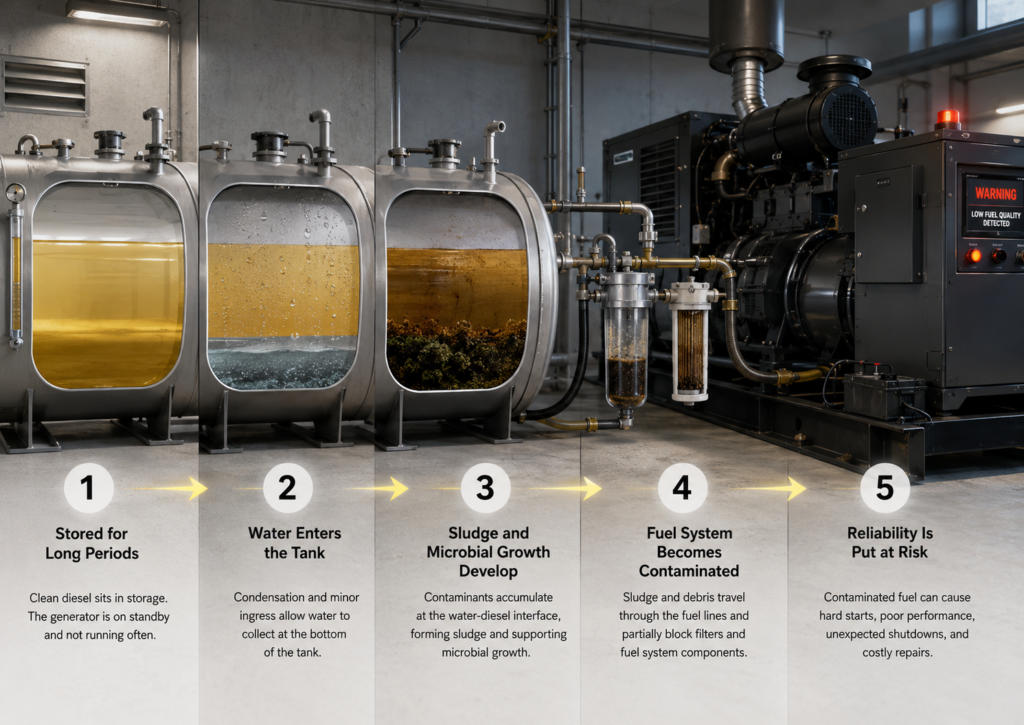
Particles, water, microbial residues and cold-temperature or additive-related material can all be relevant to filter restriction. Their diagnosis and response differ. Review seasonal conditions and fuel changes as well as tank cleanliness. Do not change the filtration specification merely to make the symptom disappear; confirm the equipment requirements and investigate why the loading increased.
Work back through the system
Map the route from delivery to storage, transfer filtration and equipment. Identify where samples or observations can usefully distinguish incoming contamination from contamination introduced or accumulated on site. After corrective work, compare the same measures: filter activity, relevant fuel findings and operating conditions. Define escalation triggers for continuing restriction instead of relying on repeated replacement alone.
From the evidence to the next action
| Finding | What to establish | Practical next step |
|---|---|---|
| Several assets affected together | Common fuel and transfer points | Review shared supply evidence |
| Restriction linked to cold periods | Fuel and material behaviour | Consult the fuel supplier and OEM |
| Water or slime observed | Water and microbial evidence | Plan targeted sampling and investigation |
| Restriction during initial cleaning | Material mobilisation and system condition | Review the treatment and monitoring plan |
Putting the guidance into practice
Illustrative decision example, not a customer case study
A fleet that changes filters soon after each delivery should compare receipt timing, tank observations and filter loading with the quieter period between deliveries. That pattern helps decide which sampling points will best distinguish the competing explanations.
Match the product to the identified task
Choose microbial testing, water management or formulation-specific treatment only where it addresses an identified part of the investigation. Keep the equipment’s filtration requirements central to the plan.
Fuel Right treatment formulations · FUELSTAT microbial testing · Aquafighter water management
Frequently asked questions
Do not depart from the required filtration specification simply to reduce maintenance. Confirm the OEM requirement and investigate the cause.
No. It assesses its defined microbial targets or output. Other physical and chemical causes may require separate analysis.
Yes. Review delivery, storage and transfer arrangements alongside the equipment itself rather than assuming a single source.
Compare agreed measures under comparable conditions, including filter activity and relevant test findings. Set the follow-up before the work begins.
Related Fuel Right Knowledge Resources


Continue the investigation
Technical references
Discuss the finding with Fuel Right Australia
Send the fuel grade, tank and fuel volumes, sample locations, operating history and available results. Include the decision you need to make and any operational constraints.
